

How to Build a Morning Yoga and Meditation Routine for a Balanced Day
Published by Vitalizen App — Your companion for yoga and meditation. Last updated: July 31, 2026.
Have you ever woken up feeling already behind? Your mind racing before your feet even touch the floor. You’re not alone. In fact, a 2026 report from the American Psychological Association shows that over 77% of people experience stress that affects their physical health — and mornings are often when it hits hardest.
But here’s the good news: a simple morning yoga and meditation routine can completely shift that narrative. It’s not about adding more to your plate. It’s about starting your day with intention, clarity, and calm — so everything else flows more naturally.
In this guide, we’ll walk you through a practical, science-backed routine that takes just 15 to 20 minutes. Whether you’re a complete beginner or a seasoned practitioner, these steps will help you build a sustainable morning practice. And if you’re looking for guided support, the Vitalizen App | Yoga + Meditation is here to help you every step of the way.
What is a Morning Yoga and Meditation Routine?
A morning yoga and meditation routine is a structured sequence of gentle physical postures and mindfulness practices performed shortly after waking. This practice involves combining breathwork (pranayama), movement (asana), and focused awareness to achieve a state of physical vitality and mental clarity. It’s a proactive way to regulate your nervous system before the demands of the day begin.
Main Characteristics of an Effective Routine
- Accessibility: Designed for all fitness levels, requiring no special equipment.
- Breath-Centric: Movement is synchronized with deep, intentional breathing.
- Consistency-Focused: Prioritizes a short, daily practice over occasional long sessions.
- Mind-Body Integration: Seamlessly transitions from physical movement to seated meditation.
How It Works to Reduce Stress
- Step 1: Activate the Parasympathetic Nervous System. Deep diaphragmatic breathing signals safety to the brain, lowering cortisol and heart rate.
- Step 2: Release Physical Tension. Gentle stretches target areas where stress is stored, like the hips, shoulders, and spine, improving circulation.
- Step 3: Train Focused Attention. The meditation component strengthens the prefrontal cortex, enhancing decision-making and emotional regulation for the rest of the day.
Why is a Morning Yoga and Meditation Routine Important for Your Health?
Before we jump into the poses and breathing techniques, let’s talk about the why. Because when you understand the impact, consistency becomes much easier.
Research from Harvard Medical School indicates that just 10 minutes of daily mindfulness can reduce anxiety, improve focus, and even lower blood pressure. When you combine that with gentle movement — like yoga — you activate your parasympathetic nervous system. That’s the part of your body responsible for “rest and digest” mode.
In practical terms, this means:
- Lower cortisol levels — less stress throughout the day
- Improved mental clarity — better decisions, fewer distractions
- Greater emotional resilience — you respond, not react
- More energy — without relying on caffeine alone
And the best part? You don’t need a gym membership or expensive equipment. Just a mat, a quiet corner, and the willingness to show up for yourself.
If you’re curious about how technology can support this journey, check out what Vitalizen.app is all about and how it combines ancient wisdom with modern convenience.
Additionally, a study from the National Institutes of Health showed that regular yoga practice reduces inflammation markers in the body. This means a morning yoga and meditation routine doesn’t just help you feel better — it also supports long-term physical health.
How to Start a 15-Minute Morning Yoga and Meditation Routine Today
This routine is designed to be accessible, effective, and adaptable. You can do it in your bedroom, living room, or even outside if the weather permits. Let’s break it down step by step.
Step 1: Mindful Awakening (2 minutes)
Before you even get out of bed, take two minutes to simply breathe. Place one hand on your belly and one on your chest. Inhale deeply through your nose for four counts, hold for four counts, and exhale slowly for six counts. This 4-4-6 breathing technique signals your nervous system that it’s safe to relax.
Notice how your body feels. No judgment. Just awareness. This small act sets the tone for the entire day.
Step 2: Cat-Cow Stretch (3 minutes)
Come to all fours on your mat. As you inhale, drop your belly, lift your chest and tailbone — that’s Cow pose. As you exhale, round your spine, tuck your chin, and draw your navel in — that’s Cat pose.
Move slowly with your breath. Repeat for 6 to 8 rounds. This sequence releases tension in the spine and wakes up your back muscles after a night of sleep.
Step 3: Standing Forward Fold with Shoulder Rolls (3 minutes)
Stand at the top of your mat. Inhale, reach your arms overhead. Exhale, fold forward from your hips, keeping a soft bend in your knees. Let your head hang heavy.
Stay here for five deep breaths. Then, roll up slowly, one vertebra at a time. At the top, roll your shoulders back and down. This movement improves circulation and releases neck and shoulder tension — a common problem for anyone who works at a desk.
Step 4: Sun Salutation A — Modified (4 minutes)
Sun Salutations are the cornerstone of many morning yoga routines. Here’s a gentle version:
- Stand tall at the front of your mat (Mountain Pose)
- Inhale, reach arms overhead (Upward Salute)
- Exhale, fold forward (Standing Forward Fold)
- Inhale, lift halfway with a flat back (Halfway Lift)
- Exhale, step or walk back to Plank or Knees-Chest-Chin
- Inhale, gently arch into Cobra or Baby Cobra
- Exhale, push back into Child’s Pose or Downward Dog
- Walk or step forward, inhale to stand, exhale to center
Repeat 3 to 5 times. Move at your own pace. This sequence warms up the entire body, improves flexibility, and builds focus.
Step 5: Seated Meditation (3 minutes)
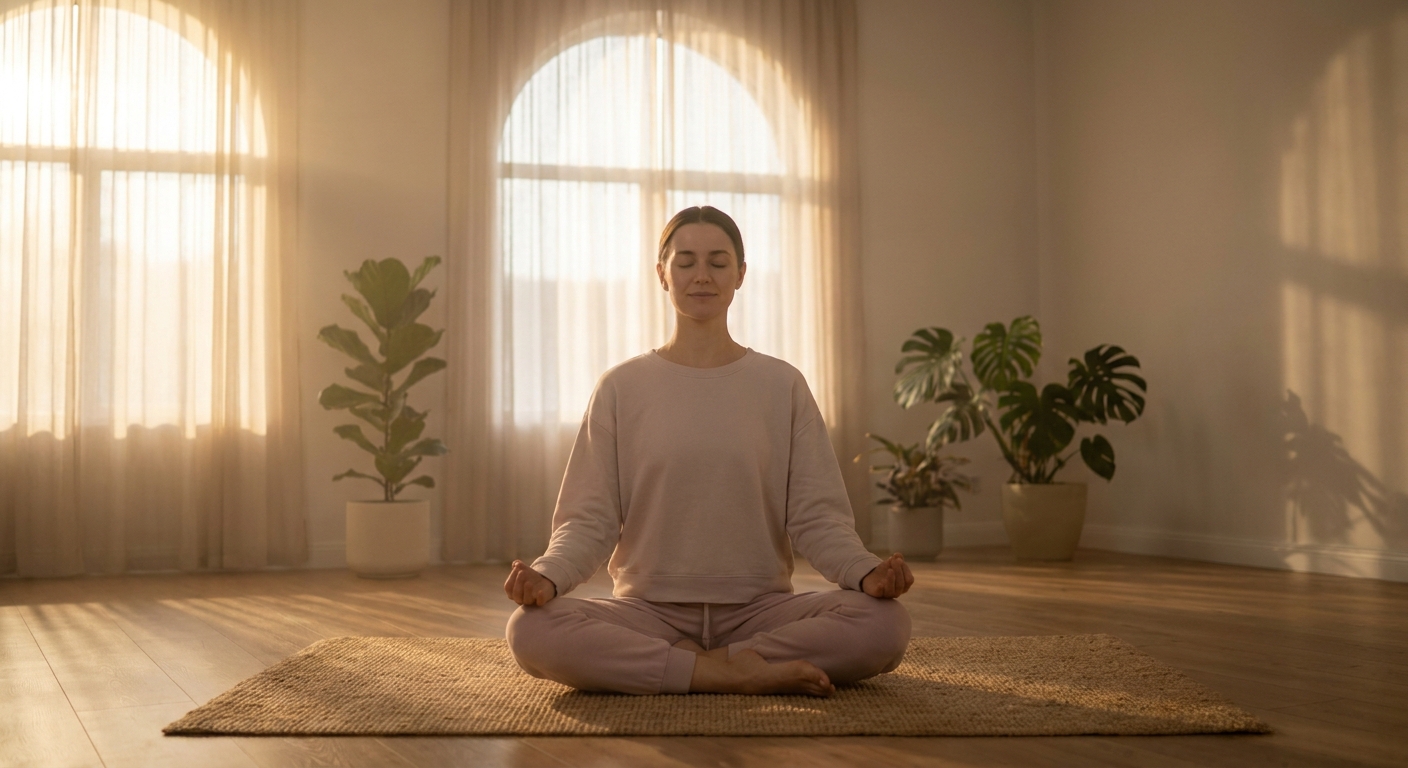
Find a comfortable seated position — cross-legged on the floor or in a chair. Close your eyes. Bring your attention to your natural breath. When your mind wanders (and it will), gently guide it back to the sensation of breathing.
You can use a simple mantra like “I am calm, I am present” or simply count your breaths. Three minutes of morning meditation can dramatically improve your focus and emotional balance for the rest of the day.
If you’d like guided sessions with professional instructors, the Vitalizen App offers structured programs that adapt to your experience level.
What Are the Most Common Challenges When Starting a Morning Routine?
Let’s be real for a moment. Building a new habit isn’t always easy. Here are the most common obstacles people face when starting a morning yoga and meditation routine — and how to overcome them.
“I don’t have time.”
Start with just 5 minutes. Seriously. A short, consistent practice beats a long, inconsistent one every time. As you feel the benefits, you’ll naturally want to make more time.
“I’m not flexible enough.”
Yoga isn’t about touching your toes. It’s about what you learn on the way down. Flexibility comes with practice. Use props like blocks or pillows, and honor where your body is today.
“My mind is too busy to meditate.”
That’s exactly why you need meditation. A busy mind isn’t a barrier — it’s the starting point. Think of it as mental training. Each time you notice your mind wandering and bring it back, you’re building your focus muscle.
“I don’t know what to do.”
This is where having a guide makes all the difference. The Vitalizen App offers step-by-step audio and video sessions, so you never have to guess the next pose or breathing technique.
“I’m worried I’ll lose motivation.”
Motivation fluctuates, but discipline can be built. The morning yoga and meditation routine becomes easier when you pair it with a reward system. For example, after your practice, enjoy a favorite tea or listen to a podcast. This positive reinforcement trains your brain to associate the routine with pleasure.
Where is the Scientific Evidence for Morning Mindfulness?
Still skeptical? Let’s look at what the research says.
“A 2022 study published in the Journal of Clinical Psychology found that participants who practiced a daily morning mindfulness routine for 8 weeks reported a 42% reduction in stress levels and a 35% improvement in sleep quality.”
Another study from the University of Southern California showed that just 12 minutes of morning meditation improved decision-making accuracy by 22%.
These aren’t abstract benefits. They translate into better relationships, higher productivity at work, and a deeper sense of fulfillment in daily life.
And when you combine yoga with meditation — as the Vitalizen methodology does — you get the best of both worlds: physical vitality and mental clarity.
Furthermore, a March 2022 APA Monitor article highlighted that mindfulness meditation can reduce symptoms of anxiety and depression, making it a powerful tool for mental health.
How to Stay Consistent With Your Practice
Consistency is the secret ingredient. Here are five strategies that actually work:
- Set a specific time. Anchor your practice to an existing habit — right after brushing your teeth, for example.
- Prepare the night before. Lay out your mat, clothes, and any props. Remove friction.
- Start small. Five minutes is a win. Celebrate it.
- Use a tracker. Marking an “X” on a calendar creates momentum and accountability.
- Get support. Having a community or an app makes the journey easier and more enjoyable.
The Vitalizen App includes progress tracking, personalized recommendations, and a supportive community to keep you motivated.
Remember, a morning yoga and meditation routine is not about perfection. It’s about showing up for yourself, day after day. Even when you miss a day, you can always restart the next morning.
Frequently Asked Questions About Morning Yoga and Meditation
How long should a morning yoga and meditation routine be?
For beginners, 10 to 15 minutes is ideal. As you build consistency, you can extend to 20 or 30 minutes. The key is regularity, not duration. Even 5 minutes of mindful movement and breathing can make a significant difference in your day.
Can I do yoga and meditation on an empty stomach?
Yes, it’s actually recommended. A light stomach allows for deeper breathing and easier movement. If you need something, try a small piece of fruit or a glass of water before your practice. Save your full breakfast for after your routine.
What if I miss a day? Should I double up the next day?
Not at all. Simply resume your normal routine the next day. Missing one day doesn’t erase your progress. What matters is your overall consistency over weeks and months. Be kind to yourself — this is a practice, not a performance.
Do I need special equipment for a morning yoga routine?
No. A yoga mat is helpful but not essential — a carpet or towel works fine. Wear comfortable clothing that allows movement. As you progress, you might add blocks, a strap, or a meditation cushion, but none of these are required to start.
Can the Vitalizen App help me build a morning routine?
Absolutely. The Vitalizen App offers guided yoga and meditation sessions designed for all levels. You can choose from morning-specific routines, set reminders, track your progress, and access a library of content that grows with you. Start your journey here.
Is it better to do yoga or meditation first in the morning?
Most experts recommend starting with gentle yoga to release physical tension, then transitioning to meditation for mental clarity. The morning yoga and meditation routine we outlined follows this sequence. However, you can reverse the order if that feels better for you. The key is consistency.
Your Morning, Your Foundation
Your morning sets the tone for everything that follows. By investing just 15 minutes in a morning yoga and meditation routine, you’re not just stretching or breathing — you’re building a foundation of calm, focus, and resilience that supports every part of your life.
Whether you’re navigating a busy career, raising a family, or simply trying to feel more present in your own skin, this practice is for you. And you don’t have to do it alone.
The Vitalizen App | Yoga + Meditation was created to make wellness accessible, enjoyable, and sustainable. With expert-led sessions, personalized plans, and a warm community of like-minded individuals, it’s the companion you deserve on this journey.
Ready to transform your mornings?
Start Your Free Trial Now
If you have questions or want to share your experience, we’d love to hear from you. Get in touch with our team or explore more articles, tips, and guides on yoga and meditation on our blog.
Disclaimer: This article is for informational purposes only and does not constitute medical advice. Always consult with a healthcare professional before starting any new exercise or wellness routine.