

Start your mornings with peace — discover morning yoga for anxiety that truly works.
Does your mind start racing the moment you wake up? You are not alone, as mornings can feel like a battle before the day even begins. But what if you could change that in just 10 to 15 minutes? A consistent morning yoga for anxiety routine can shift your entire day from chaos to calm. This practice involves intentional movement and breathwork to activate your body’s natural relaxation response, promoting a yoga for calm mind state that lasts for hours. Ready to begin? Let’s explore the best poses you can do right now — on your mat, in your pajamas, wherever you are.
Why Is Morning Yoga Essential for Anxiety Relief?
Your cortisol levels are naturally at their peak in the morning. This “stress hormone” gives you the boost to wake up, but for those prone to anxiety, it can feel more like a flood than a gentle wave. The beauty of a practice offered by Vitalizen App | Yoga + Meditation lies in meeting your body where it is.
By practicing morning yoga poses for anxiety, you can gently signal your nervous system that it is safe to rest. Slow, intentional movement paired with conscious breathing reduces your heart rate, lowers blood pressure, and shifts the brain from a fight-or-flight mode to a rest-and-digest state.
Moreover, a consistent morning practice builds resilience over time. You are not only calming today’s anxiety; you are rewiring your brain’s response to stress for the long haul. And the best part? You do not need to be flexible, strong, or experienced. These anxiety relief yoga poses are accessible to everyone.
“Studies show that yoga activates the parasympathetic nervous system, reducing cortisol levels and promoting a yoga for calm mind response that lasts for hours.” — Vitalizen Research Digest, 2026
Key Benefits of a Morning Yoga Practice
- Lower morning cortisol: Reduced stress levels from the moment you wake up
- Improved mental clarity: A sharper focus and better emotional balance throughout the day
- Gentle physical awakening: Eases muscles and joints without strain
- Greater sense of control: Start your day with intention, not reaction
- Increased mindfulness: Cultivate a state of presence even before your first cup of coffee
If you are new to yoga, do not worry. You can start with just five minutes a day. For guidance and personalized routines, explore Comece agora sua jornada de bem estar, and let Vitalizen guide you every step of the way.
1. Child’s Pose — Balasana for Surrender and Grounding
Best for: Immediate grounding and calming an overwhelmed mind.
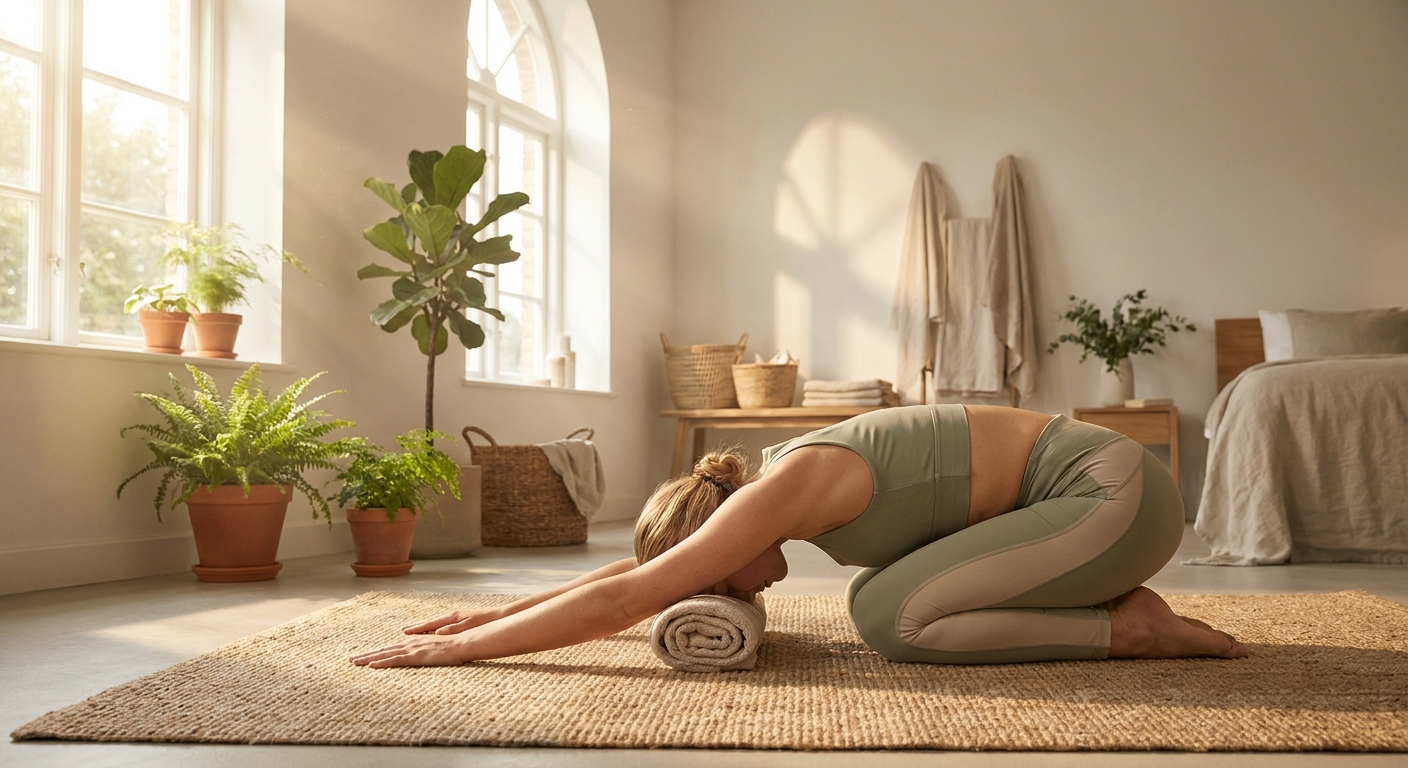
Child’s Pose is often the first posture taught in any best yoga for stress sequence, and for good reason. It encourages inward focus, lengthens the spine, and massages the internal organs. When anxiety feels overwhelming, this pose serves as your emotional anchor.
How to Perform Child’s Pose
- Kneel on your mat with big toes together and knees hip-width apart.
- Exhale and lower your torso between your thighs.
- Extend your arms forward or rest them alongside your body.
- Rest your forehead on the mat or a block. Breathe deeply for 5 to 10 breaths.
As you hold the pose, imagine each exhale releasing tension from your shoulders and jaw. This is one of the most powerful anxiety relief yoga poses because it activates the vagus nerve, which helps lower heart rate and promotes a profound sense of safety.
2. Cat-Cow Stretch — Marjaryasana-Bitilasana to Awaken the Spine
Best for: Releasing tension stored in the back and neck.
If you often wake up with a stiff neck or tight shoulders, the Cat-Cow stretch is your go-to solution. This gentle spinal warm-up synchronizes breath with movement, making it an ideal morning yoga for anxiety flow to transition from sleep to awareness.
How to Perform Cat-Cow Stretch
- Start on your hands and knees in a tabletop position.
- Inhale as you drop your belly, lift your chest and tailbone (Cow Pose).
- Exhale as you round your spine, tuck your chin, and draw your navel in (Cat Pose).
- Repeat slowly for 6 to 8 rounds, moving with the rhythm of your breath.
The slow, continuous movement helps release physical tension, while the conscious breathwork calms your nervous system. This is a wonderful way to ease into a full morning yoga routine without shocking your body awake.
3. Standing Forward Fold — Uttanasana to Release a Heavy Head
Best for: Relieving anxiety-induced headaches and mental fog.
When anxiety builds pressure in your head, folding forward can feel like a release valve. This gentle inversion encourages blood flow to the brain while calming the mind through the physical sensation of surrender. It is one of the most effective yoga poses for calm mind and clarity.
How to Perform Standing Forward Fold
- Stand with feet hip-width apart and a slight bend in your knees.
- Exhale and hinge at your hips, folding your torso over your legs.
- Let your head hang heavy. Hold onto opposite elbows or place your hands on the floor.
- Stay for 5 to 8 breaths. To come out, roll up slowly on an inhale.
Always keep a microbend in your knees to protect your hamstrings. Focus on the sensation of letting go with each exhale. This posture is a must-have in any best yoga for stress toolkit.
4. Downward-Facing Dog — Adho Mukha Svanasana for a Full-Body Reset
Best for: A full-body stretch that renews your energy.
Downward Dog is perhaps the most recognized yoga pose worldwide, and for good reason. It stretches the entire posterior chain, strengthens your arms and legs, and brings fresh oxygen to the brain. This posture is a core component of any morning yoga for anxiety sequence because it simultaneously energizes and calms you.
How to Perform Downward-Facing Dog
- From a tabletop position, tuck your toes and lift your hips toward the ceiling.
- Press your hands firmly into the mat, keeping your spine long.
- Allow your head to hang freely between your arms. Gently pedal your feet.
- Hold for 5 to 10 deep breaths, then release back to tabletop.
If your hamstrings feel tight, keep a generous bend in your knees. The goal is not a perfectly straight line, but rather a calm spine and a steady breath.
5. Legs-Up-The-Wall — Viparita Karani as the Ultimate Anxiety Antidote
Best for: Deep relaxation and immediate nervous system regulation.
If you have ever felt your heart racing from anxiety, this pose is a literal lifesaver. Legs-Up-The-Wall is a restorative inversion that powerfully activates the parasympathetic nervous system, your body’s natural “off switch” for stress. Clinical research highlights this pose as one of the most effective anxiety relief yoga techniques available.
How to Perform Legs-Up-The-Wall
- Sit sideways with one hip touching a wall.
- Gently swing your legs up the wall as you lie down on your back.
- Your legs should rest vertically, with your arms relaxed at your sides, palms facing up.
- Close your eyes and breathe naturally for 3 to 5 minutes.
This pose reduces swelling in the legs, lowers blood pressure, and calms the mind almost instantly. It is perfect for mornings when anxiety feels especially heavy.
6. Tree Pose — Vrikshasana to Find Your Balance and Focus
Best for: Building mental focus, physical balance, and inner confidence.
Anxiety often makes us feel unsteady, both physically and emotionally. Tree Pose teaches you to find stability and balance, even when your mind wants to wobble. By rooting down through one foot and reaching up through your arms, you create a sense of grounded strength that carries into your day.
How to Perform Tree Pose
- Stand tall and shift your weight onto your left foot.
- Place the sole of your right foot on your left inner thigh or calf (avoid the knee joint).
- Bring your hands to your heart center or reach them overhead like branches.
- Fix your gaze on a steady, unmoving point. Hold for 5 breaths, then switch sides.
If balancing is difficult, stand near a wall for support. The practice is not about achieving a perfect posture; it is about finding calm amidst the natural wobble. This pose is a gem in any morning yoga routine focused on mental clarity.
7. Corpse Pose — Savasana to Master the Art of Conscious Rest
Best for: Integrating your entire practice and experiencing deep, healing relaxation.
Many people skip Savasana because they think it is “just lying there.” In truth, this is where the deepest healing happens. When you lie still, your body processes the movement, your breath deepens, and your mind begins to settle. It is the ultimate yoga for calm mind posture and is non-negotiable if you want lasting anxiety relief.
How to Perform Corpse Pose
- Lie flat on your back with your legs slightly apart and arms at your sides, palms facing up.
- Close your eyes and perform a mental body scan from head to toe, consciously releasing any tension.
- Breathe naturally and without effort. Stay in this state for 3 to 5 minutes.
To gently reawaken, wiggle your fingers and toes, then roll to one side and pause before slowly sitting up. Your nervous system will thank you.
The Science Behind Yoga and Anxiety
A growing body of research supports the use of yoga as an effective complementary treatment for anxiety disorders. According to a 2023 meta-analysis published in the Journal of Psychiatric Research, regular yoga practice significantly reduces symptoms of generalized anxiety disorder, panic disorder, and social anxiety. The mechanisms include modulation of the hypothalamic-pituitary-adrenal (HPA) axis, increased GABA levels, and enhanced vagal tone.
For a deeper dive into the evidence, you can read the full study at the National Institutes of Health (NIH) database. Another excellent resource is the Harvard Health article on yoga for anxiety and depression, which explains how even short daily practices can rewire the brain’s stress response.
Understanding the science behind morning yoga for anxiety can motivate you to stay consistent. Each pose you practice is not just a stretch — it is a physiological intervention that lowers cortisol, increases serotonin, and trains your nervous system to remain calm under pressure.
Tips for Beginners Starting Morning Yoga for Anxiety
Starting a new routine can feel daunting, but these tips will help you build a sustainable morning yoga routine that actually sticks:
- Start small: Commit to just 5 minutes. You can always add more time later.
- Create a calm space: Designate a corner of your room with a mat, a cushion, and soft lighting.
- Use props: Blocks, blankets, and walls are your friends. They make poses accessible and comfortable.
- Focus on breath: If your mind wanders, gently bring it back to the sensation of inhaling and exhaling.
- Be kind to yourself: Some days will feel easier than others. The goal is not perfection, but presence.
For guided support, the Vitalizen beginner program offers step-by-step video sessions that make it easy to stay on track. You can also explore our meditation for anxiety guide to complement your yoga practice.
How Can You Build a Simple Morning Yoga Routine for Anxiety?
Consistency matters far more than duration. If you can commit to 10 minutes each morning, you will notice a significant shift in your stress levels and overall well-being within two weeks. Your ability to manage anxiety will improve, and you’ll approach your day with more clarity and calm.
Your 15-Minute Morning Sequence
Here is a simple, effective sequence combining all seven poses designed for morning yoga for anxiety:
- Child’s Pose — 2 minutes
- Cat-Cow Flow — 2 minutes
- Standing Forward Fold — 1 minute
- Downward-Facing Dog — 2 minutes
- Legs-Up-The-Wall — 3 minutes
- Tree Pose — 1 minute each side
- Savasana — 3 minutes
This sequence is the perfect way to start your day. But if you want expert guidance, structure, and a supportive community, you do not have to do it alone. The Vitalizen App offers curated yoga and meditation sessions specifically designed for anxiety relief. Whether you are a complete beginner or an experienced practitioner, there is a path for you.
Ready to transform your mornings? Start your wellness journey today with Vitalizen and experience the difference a calm morning can make.
And if you have questions, need support, or want to share your progress, reach out to our team anytime. We would love to hear from you.
Frequently Asked Questions About Morning Yoga for Anxiety
Can morning yoga really reduce anxiety?
Yes. Numerous studies confirm that a regular yoga practice significantly reduces cortisol levels, lowers your heart rate, and improves mood regulation. Morning yoga for anxiety is particularly effective because it sets a calm tone for the rest of your day, preventing stress from building up early.
How long should I practice morning yoga for anxiety relief?
Even 5 to 10 minutes can make a difference. For noticeable, lasting benefits, aim for 15 to 20 minutes daily. The key is consistency and not intensity. Using a guided app like Vitalizen can help you stay on track without overwhelming your schedule.
Do I need to be flexible to do these anxiety relief yoga poses?
Not at all. These poses are beginner-friendly and can be easily modified with props like blocks, blankets, or a wall. Yoga is not about touching your toes; it is about connecting your breath and movement. Flexibility will come with time, but the calming benefits are immediate.
What is the best time to do yoga for anxiety — morning or evening?
Both have benefits, but morning yoga for anxiety is especially powerful because it helps regulate cortisol levels before they spike. Evening yoga can help unwind the day’s tension. For maximum benefit, consider a short morning practice and a gentle evening wind-down. The Vitalizen App offers routines for both.
Can I do yoga for anxiety if I have never practiced before?
Absolutely. The poses in this article are designed for all levels. Start slowly, listen to your body, and never force a stretch. If you want extra guidance, the Vitalizen beginner program walks you through every pose with video and audio cues, which is perfect for building confidence.
What if I don’t have a yoga mat? Can I still practice?
Yes! You can practice on a carpet, a towel, or any comfortable, non-slip surface. Everyday props like pillows, blankets, and walls work just as well as blocks and straps. The most important element is your intention and breath, not the equipment.
Disclaimer: This article is for informational and educational purposes only and does not substitute professional medical advice. If you have a diagnosed anxiety disorder or any medical condition, consult your healthcare provider before starting a new exercise routine.
Which Pose Will You Try Tomorrow Morning?
Anxiety does not stand a chance against a consistent practice, but it all starts with that first single pose. Tell us in the comments: Which of these 7 morning yoga poses for anxiety are you most excited to try? Or do you have a favorite already? Share your experience and help inspire someone else who is just beginning their journey.
And if you found this guide helpful, explore more articles, tips, and guided practices on our blog. Your calm mind is just a breath away.
💡 Tip: Download the Vitalizen app for free and get a personalized morning yoga plan tailored to your anxiety level. Start your free trial today!